What shape indicates a weak branch attachment compared to a strong one?
Select one answer.
Start by reading the tree, not the saw
Most bad pruning happens before the blade ever touches wood. The cut itself is easy; deciding where to cut is the hard part. If you remove the wrong branch, or cut in the wrong spot, you can leave a wound the tree cannot seal, or push it toward the weak structure that causes storm failure later.
The fix is to slow down and read the tree's architecture first. Structural pruning aims to develop and maintain stable trees, and poor structure often results in breakage of major limbs and contributes to overall tree failure (Bartlett Tree Experts). Before you cut, you need to answer three questions: Where is the branch collar? Is there a single dominant leader? Are the branch attachments strong or weak?
Find the branch collar before anything else
The branch collar is the raised, wrinkled tissue encircling where a branch emerges from the trunk or a larger branch (Friends of Trees). It is not cosmetic. It contains a protective chemical zone that inhibits the movement of decay organisms from dead or dying branches into healthy wood (Purdue Landscape Report).
Your cut goes immediately outside that collar — not flush against the trunk, and not leaving a long stub. Cutting into the collar removes the tree's own defense. Leaving a stub creates a physical barrier that stops the collar's specialized cells from growing over and sealing the wound (UC Marin Master Gardeners).
On some species the collar is subtle. When it is not obvious, imagine a line parallel to the branch that will remain, then mirror the angle of the branch bark ridge to find the correct cut angle.
Check for a single dominant leader
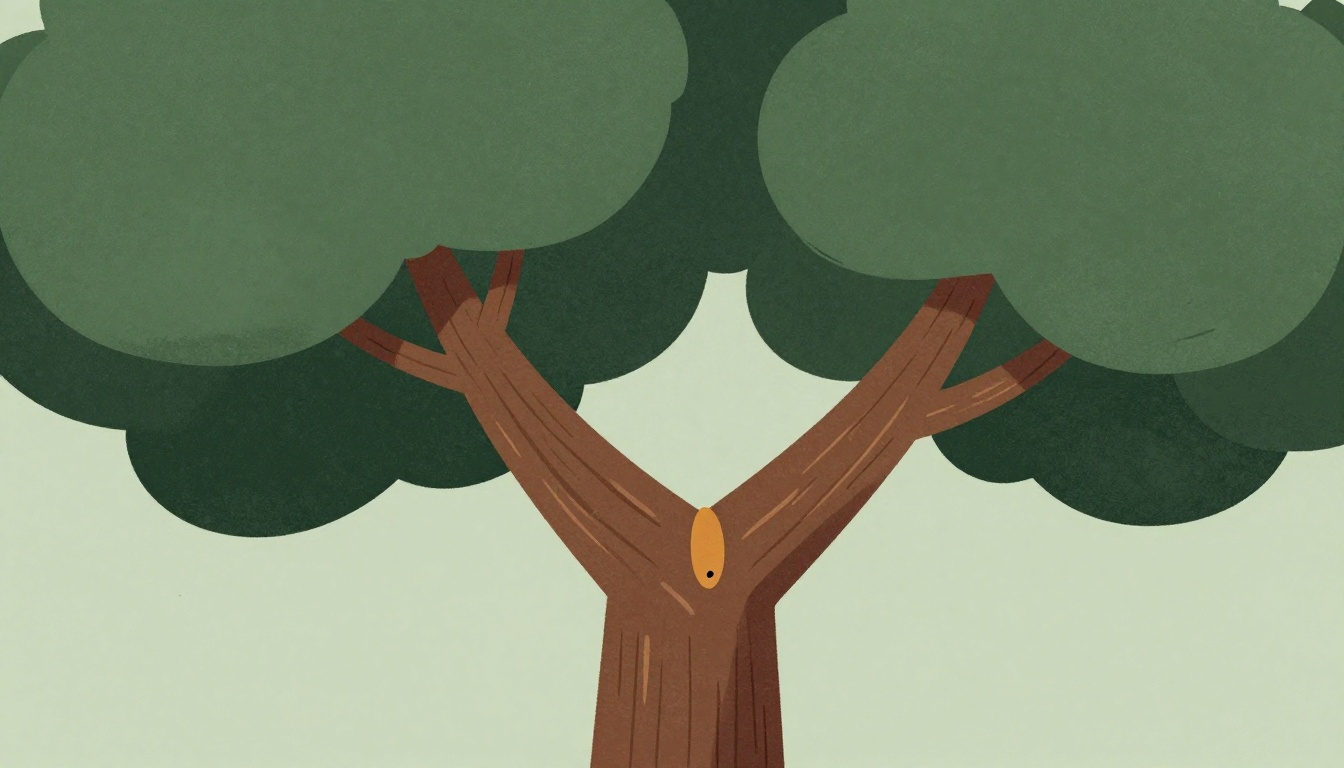
A strong tree usually has one central trunk. Codominant stems — two or more stems competing as trunks — create a weak point. When you look at codominant stems, the space between them often looks like a "V" shape, whereas a strong branch attachment looks more like a "U" shape (City of Edmond, OK).
To read this on your own tree:
- Find the healthiest, most central stem free of defects.
- Identify any stems competing with it for dominance.
- Plan to remove or subordinate the competitors back to the trunk or with a reduction cut.
This is the core of structural pruning, and it matters most on young to medium-age trees (TCI Magazine).
Scan for the defects worth removing
Walk around the tree and look for branches that meet any of these criteria before you decide on cuts:
- Dead, dying, or severely diseased branches.
- Branches growing toward or across the tree's center.
- Crossed limbs that rub together or will rub soon.
- V-shaped crotches where you can safely prune.
- Multiple leaders competing as secondary trunks.
- Sprouts forming at the base of the trunk.
These are the standard targets for a structural pruning pass (New Mexico State University).
Respect the pruning budget
Reading structure also means knowing how much you can safely remove. Do not remove more than 30% of the canopy at once; removing too much stresses the tree and can trigger unwanted sprouting or decline (City of Edmond, OK). Trees should not be raised more than a foot or two during one pruning cycle, and a large number of branches should never be removed at one time (Portland.gov).
Some objectives, like correcting a codominant stem, may need to be addressed over several seasons rather than in one session.
A pre-cut checklist you can use today
- Identify the branch collar on every branch you plan to remove.
- Confirm whether the tree has one dominant leader or competing stems.
- Mark the branches that are dead, crossing, rubbing, or V-shaped.
- Decide which cuts are removal cuts and which are reduction cuts.
- Estimate what percentage of the canopy you are removing — keep it under 30%.
- For any branch over 1 inch in diameter, plan a three-cut method to avoid tearing bark.
- Step back and look again before you make the first cut.
If you can answer these questions confidently, you are ready to cut. If you cannot, wait. A tree does not heal wounds; it seals them off, and a large cut exposes a large area for the tree to seal (City of Edmond, OK). Reading structure first is how you keep that sealed area small.
How the Featured Expert Can Help
TerraFae Flowers offers sustainable landscape design and master pruning services, creating custom garden plans for clients. They provide DIY garden packages and full design support, emphasizing sustainability and personalized service. If you want hands-on guidance reading your own trees before you cut, you can learn more at terrafaeflowers.com.