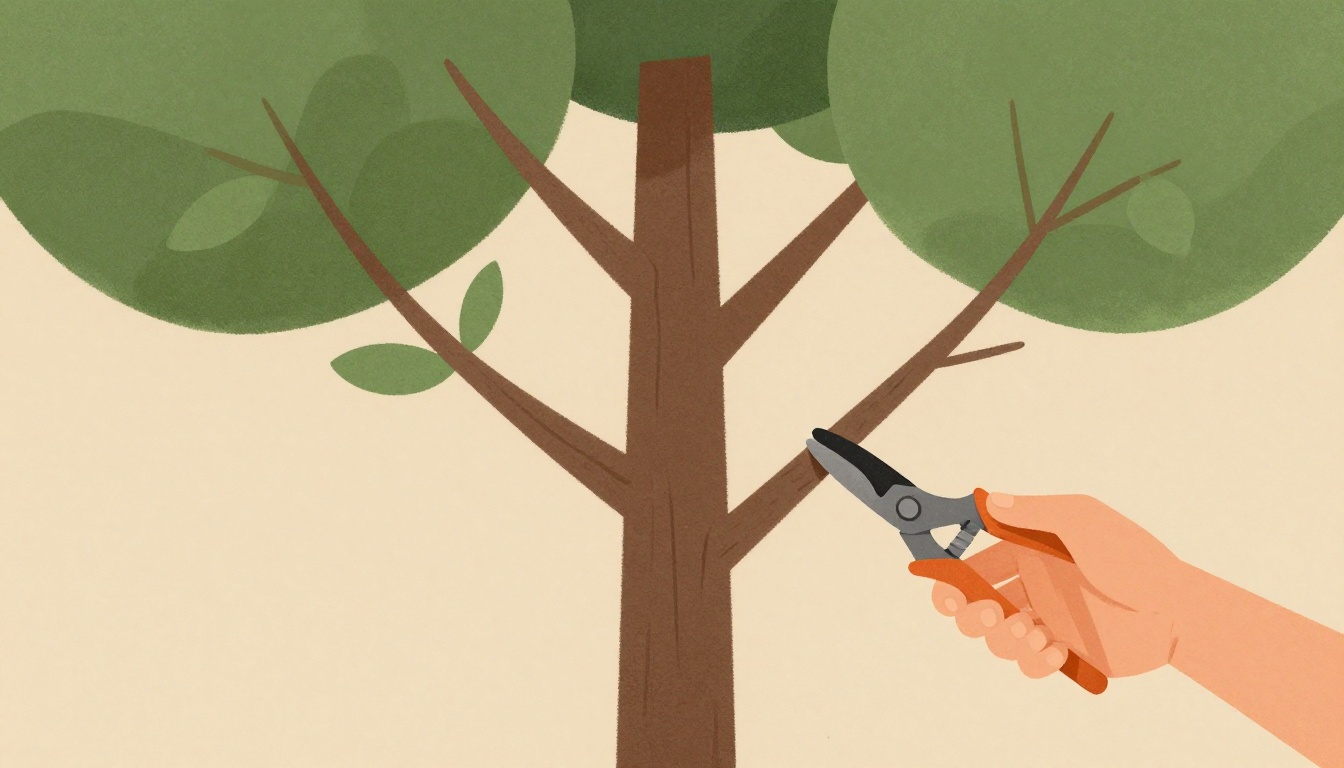
A young tree that is never pruned often grows into a mature tree with weak, crowded branch unions that can split in a storm. The good news is that the fix is cheap and simple if you start early: structural pruning in the first five years after planting shapes a strong framework and reduces the need for costly corrective work later.
According to CSU Extension, how far apart should scaffold branches be spaced?
Select one answer.
Why young-tree pruning matters
Structural pruning is the practice of guiding a young tree's growth so it develops a strong, well-spaced branch structure that can support it as it matures. Done early, it helps prevent competing trunks, weak attachments, and storm-related branch failure, and it often reduces the need for major corrective pruning or even tree removal later (Ahlum & Arbor).
Trees in a landscape grow differently than trees in a forest. Without competition for light, they tend to develop multiple competing leaders and large lateral branches, which raises their risk of failure without structural pruning (CSU Extension).
Start at planting, then commit to five years
Pruning should begin at the time of planting, but keep it minimal. Limit cuts at planting to removing only weak, dead, diseased, rubbing, or injured branches so the tree can use its foliage to build roots and overcome planting stress (Iowa State Extension).
After that, commit to checking structure each spring for the first five years. Young trees should be structurally pruned or trained in the first five years after planting, or as early as possible, to minimize future tree or branch problems.
The 5-step structural pruning routine
- Clean up first. Remove dead, broken, or crossing branches, watersprouts, and suckers. This gives you a clear view of the tree's real structure.
- Choose one central leader. Select the tallest, straightest, healthiest stem as the dominant leader. Remove or shorten any competing upright stems that are more than half the diameter of that leader.
- Set the lowest permanent branches. Decide where the permanent scaffold branches will start, then remove branches below that point — but not all in one year.
- Space the scaffolds. Aim for well-spaced branches along the trunk. CSU Extension recommends spacing scaffold branches with 3% or more of the tree's expected mature height between them.
- Keep the pruning dose small. Don't remove more than 25% of the live canopy in any one year.
Fix codominant stems early
Codominant stems are two or more stems growing upward from a single point, forming a V-shaped crotch. They create a weak point because there is less direct wood connection, and included bark — bark trapped between the stems — makes the attachment even weaker (Bartlett Tree Experts).
To correct one, choose which stem to keep as the main trunk, then reduce the size of the other rather than removing it outright in a single cut. Removing a codominant stem early lets the cut seal and lets the tree resume a desirable structure (Florida Urban Forestry Council).
Make clean cuts outside the branch collar
Every cut is a wound. Trees don't heal like humans — they seal over the wound, and it stays contained inside the tree forever. Smaller cuts are less harmful than larger ones, so fixing problems while the tree is young avoids big pruning jobs later (Texas A&M Forest Service).
- Remove whole branches with a cut just outside the branch collar, the swollen area where branch meets trunk. Never cut flush with the trunk.
- To shorten a branch, cut back to a lateral branch that is at least one-third the diameter of the branch you're removing.
- Use bypass hand pruners or loppers for branches under one inch, and a pruning saw for larger branches. Keep tools clean and sharp.
When to prune
Winter is the best time for structural pruning on shade trees. The tree is dormant, and on deciduous trees you can see the branching structure clearly without leaves. Avoid pruning in spring, summer, and fall except to remove suckers, watersprouts, or broken, dead, or diseased branches. Note that fruit trees follow different rules — these structural methods can reduce fruit production.
Quick checklist
- Remove dead, damaged, diseased, and rubbing branches first.
- Select one dominant central leader.
- Remove or subordinate competing stems more than half the leader's diameter.
- Space scaffold branches at least 3% of mature height apart.
- Cut outside the branch collar — never flush.
- Remove no more than 25% of the live canopy per year.
- Prune in winter dormancy for shade trees.
How the Featured Expert Can Help
TerraFae Flowers offers sustainable landscape design and master pruning services, creating custom garden plans for clients. They also provide DIY garden packages and full design support, with an emphasis on sustainability and personalized service. If you want hands-on guidance for your young trees or a plan tailored to your space, visit TerraFae Flowers.