A hedge that looks thin at the base and bushy on top is usually a pruning problem, not a plant problem. When the top is wider than the base, it shades the lower foliage, and those leaves thin out over time. The fix is a combination of shape, timing, and cut size — not harder cutting.
This guide explains how to prune a hedge so it stays dense from soil to tip, using techniques that match how hedges actually grow.
Which hedge profile best keeps foliage dense down to the base?
Select one answer.
Why hedges go bare at the bottom
Hedge density depends on light reaching the lower branches. The New York Botanical Garden's pruning guide is direct about this: the top of the hedge should be narrower than the base, so the sides slope outward and sunlight reaches the foliage at the base. Without adequate light, the base becomes bare and unsightly.
The University of Georgia's pruning publication makes the same point in reverse: tapering toward the bottom reduces light penetration and causes leaves to thin near the base, while tapering toward the top allows light in.
So the single most important shaping decision is the taper. A hedge with vertical sides or an overhanging top will slowly lose its lower leaves, no matter how often you trim it.
Shape first: build a taper
Before you make a single cut, decide the profile. For most formal hedges, aim for a flat top with sides that slope outward toward the ground — sometimes called an A-frame or trapezoid shape.
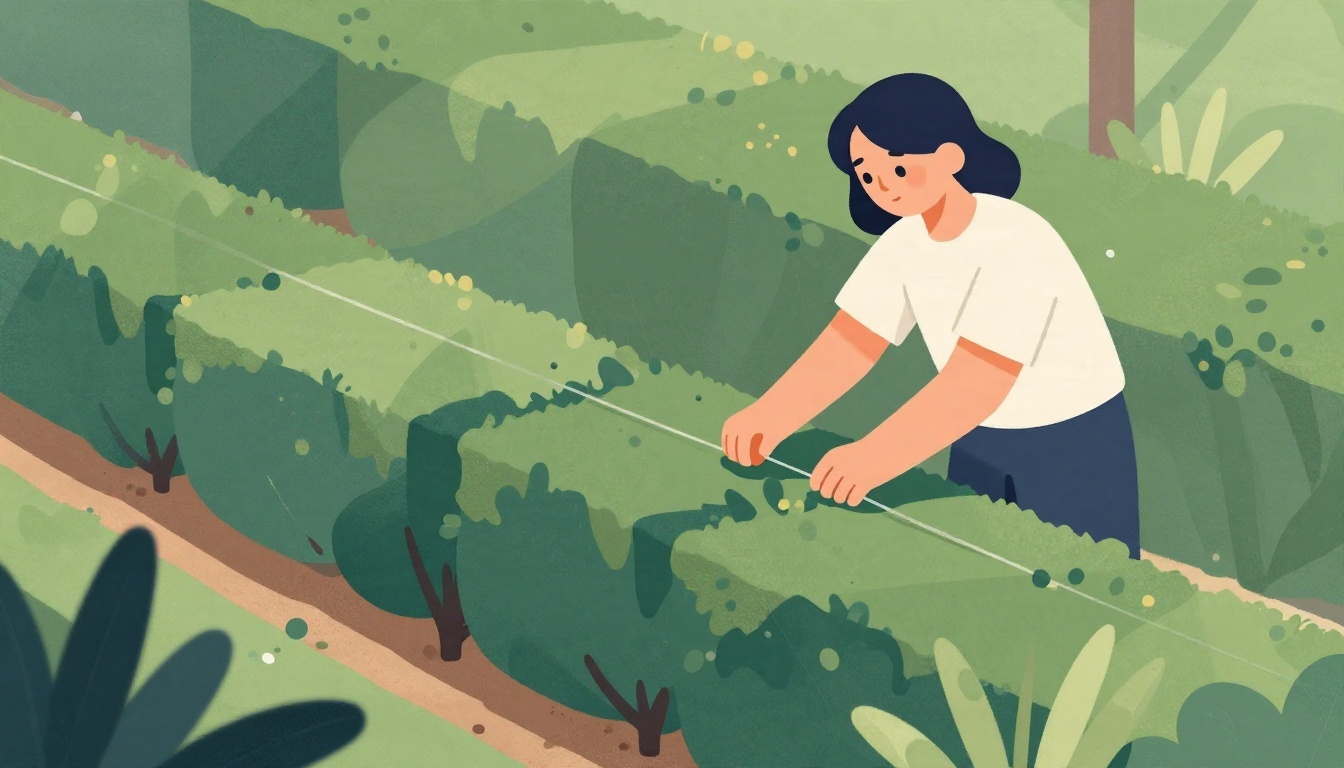
A practical way to hold the line is a string guide. The New York Botanical Garden recommends stretching a string horizontally between two upright posts to act as a guide, then trimming to that line. Your eye drifts; a string does not.
Rounded or domed tops are an option in areas with heavy snow or ice, since they shed accumulation better than a flat top. But keep the base wider than the top in every case.
Cut lightly and often
Trimming is a form of light pruning, generally only removing growth less than a year old, according to the RHS guide to trimming hedges. That distinction matters: light, regular cuts stimulate dense side growth, while a single heavy cut can leave a hedge looking bare.
ABC Gardening Australia's hedge pruning Q&A puts numbers on it: regular tip-pruning of 2–5cm encourages side shoots and helps fill out the hedge. In the second and third years, start shaping the sides to the desired line.
Frequency depends on the species and the look you want. The RHS notes formal hedges may need trimming up to three times a year. The New York Botanical Garden gives a useful contrast: a fast-growing hedge such as privet needs pruning three or four times a year, while a slow-growing hedge such as yew is usually fine with once a year in mid-summer.
Follow the one-third rule
Never remove more than one-third of a shrub's volume in a single year. This is a widely repeated guideline in hedge care, and it protects the plant from stress while leaving enough growth to fill back in.
For an overgrown hedge, work in stages rather than trying to fix everything in one session. Cutting back hard all at once can leave bare patches that take seasons to recover.
One important exception: conifers. Many conifers will not regrow from old, bare wood, so cutting into brown interior growth can leave a permanent gap. On conifers, stay within young green growth.
Match the method to the hedge type
Shearing and selective pruning are not interchangeable.
- Formal hedges — tight geometric lines, uniform surface. Shearing is appropriate, but don't shear more than once a year, and alternate between shearing and thinning to keep plants healthy, per the University of Maryland Extension.
- Informal hedges — looser, natural form. Use selective branch-by-branch cuts with hand pruners rather than running shears across the surface.
- Flowering hedges — prune immediately after bloom so you don't cut off next year's flower buds.
Maryland Extension also warns that constantly shearing boxwood creates dense growth that can lead to disease problems, and recommends periodic thinning instead.
Time it to the growing season
For most hedges, the main pruning window is spring, with a lighter tidy-up in summer. Avoid hard pruning in winter, when the plant isn't growing and cuts can be exposed to frost damage.
Delay pruning if birds are nesting in the hedge, and give them time to raise their young before you cut.
A practical checklist
- Check the profile: base wider than top, sides sloping outward.
- Set stakes and a string line before the first cut.
- Sharpen and lubricate your tools so cuts are clean, not torn.
- Remove no more than one-third of the plant's volume in a year.
- Take light tip cuts of 2–5cm on young hedges to encourage side shoots.
- Alternate shearing with thinning on formal hedges.
- Stay in green growth on conifers — never cut into bare old wood.
- Prune flowering hedges right after bloom.
- Skip hard winter pruning and pause for nesting birds.
Quiz: test your hedge pruning knowledge
Answer this before you pick up the shears — it covers the single most common shaping mistake.
{"question":"Which hedge profile best keeps foliage dense down to the base?","options":["A top narrower than the base, so light reaches lower foliage","Vertical sides with a flat top for a crisp formal look","A top wider than the base to shade the roots"],"correctIndex":0}
How the Featured Expert Can Help
TerraFae Flowers offers sustainable landscape design and master pruning services, creating custom garden plans for clients. They also provide DIY garden packages and full design support, with an emphasis on sustainability and personalized service. If you want help shaping a hedge correctly or planning long-term garden care, you can visit TerraFae Flowers.