After a storm, the first instinct is often to grab a saw and start cutting. But damaged trees are unpredictable, and the wrong cut can turn a survivable injury into a hazard or a slow decline. The goal is simple: remove what is dangerous or unsalvageable, protect the tree's ability to seal its wounds, and leave the rest for the tree to recover.
What is the correct order of cuts in the three-cut method for removing a large damaged limb?
Select one answer.
Start with safety, not saws
Before you touch a branch, assess the whole tree from the ground. Look for broken, split, or hanging branches in the canopy and any splits in the trunk. If a tree has fallen into a road, walkway, or brought down power lines, call 911 or your local non-emergency line first, and stay away from downed lines. Document damage with photos for your insurance company before cleanup begins.
All loose branches should be removed as soon as possible to eliminate the chance of injury or damage if they were to fall, according to UNH Extension. But it is not safe to attempt to remove broken branches dangling too high to reach—even with a ladder. The safest option is to have a professional handle anything you cannot reach safely from the ground, as Elite Tree Care notes.
Decide what actually needs to come off
Not every damaged branch requires removal. Prioritize in this order:
- Loose or hanging branches — remove immediately.
- Cracked or broken branches — remove after loose material is cleared.
- Bent branches that never straightened — these may have internal cracks and should be considered for removal.
- Branches stripped of more than a third of their bark circumference — remove them; they will always be structurally weak.
Only prune the most hazardous branches. The tree is already under stress, so the less you cut, the better. Leave light cosmetic pruning for later, ideally late winter or early spring while the tree is dormant.
Make the cut correctly: the three-cut method
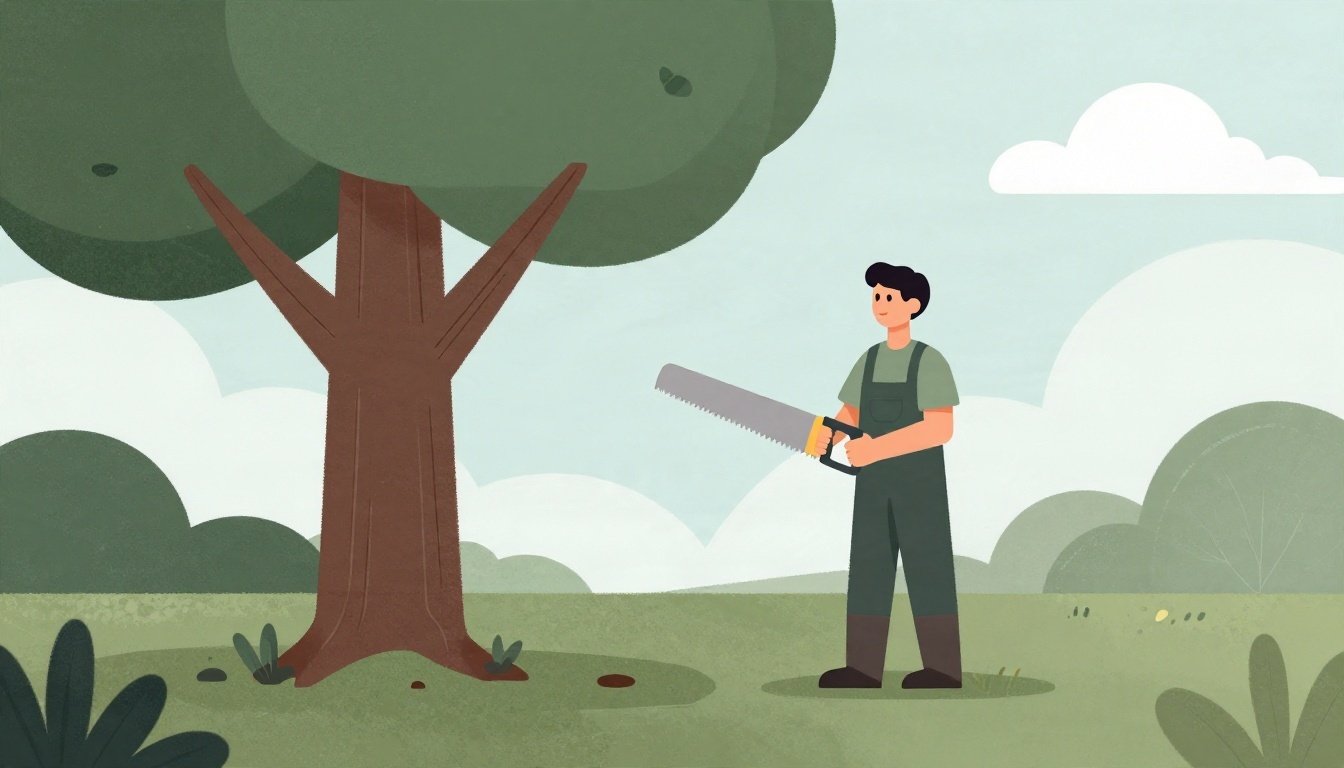
For any branch larger than about 1 inch in diameter, use the three-cut method to prevent bark tearing. The technique involves an undercut to prevent bark tearing, a second cut to remove the branch's weight, and a final cut at the branch collar, as described by LSU AgCenter.
- Undercut: About several inches out from the trunk, cut upward into the underside of the branch roughly one-third of the way through.
- Top cut: A few inches farther out, cut down from the top until the branch falls, leaving a stub.
- Final cut: Remove the stub just outside the branch collar—the swollen area where the branch meets the trunk. Do not cut into the collar.
A proper pruning cut begins just outside the branch bark ridge and angles down and slightly away from the trunk, avoiding injury to the branch collar, per Nebraska Extension. Cutting into the collar interferes with the tree's natural ability to seal the wound and invites decay.
Match the tool to the branch
- Bypass pruners: branches under ⅓ inch.
- Loppers: branches ⅓ to 1 inch.
- Hand saw or pruning saw: branches 1 inch and larger.
For smaller branches up to 4 inches in diameter, a good, sharp bow saw or pruning saw is the most appropriate tool, according to Iowa State Extension. Wear eye and hand protection at minimum, and a helmet when cutting overhead. Work only from the ground on safe, flat surfaces—never from roofs or ladders.
Know when to stop and call a pro
Trees too large to handle from the ground should be pruned only by professional arborists. Stop and call for help if:
- The branch is too high to reach safely from the ground.
- The trunk is split or the tree is uprooted or leaning.
- The tree is near power lines or structures.
- You see signs of disease or pests after cleanup.
Improper pruning after storm damage can weaken the tree and make it more susceptible to insect infestations or diseases, leading to further damage during the next storm. After the initial cleanup, monitor the tree through the following growing season and watch for decline.
Quick post-storm checklist
- Assess the tree from the ground; photograph damage.
- Call emergency services for downed lines or blocked roads.
- Remove loose and hanging branches first.
- Use the three-cut method on any branch over 1 inch.
- Keep cuts outside the branch collar.
- Clear debris and monitor for pests or disease.
- Schedule any larger work with a professional.
How the Featured Expert Can Help
TerraFae Flowers offers sustainable landscape design and master pruning services, creating custom garden plans for clients. They also provide DIY garden packages and full design support, emphasizing sustainability and personalized service. If storm damage has left you unsure what to cut or how to plan recovery, you can learn more at terrafaeflowers.com.
Test your knowledge
Storm-damaged trees need careful decisions. Here is one quick check on the method that protects the tree while you remove a heavy limb.